
Quilting Terms AI Can't Explain (Yet)
Quilting has its own language, filled with terms that can confuse even the most advanced AI. Words like "jelly roll" and "quilt sandwich" sound like food but have entirely different meanings in sewing. These terms often rely on hands-on experience to fully understand, making them tricky for AI to explain.
For example, a "quilt sandwich" refers to layering the quilt top, batting, and backing before quilting. "Fussy cutting" is the art of cutting fabric to highlight specific designs, and "chain piecing" saves time by sewing pieces in a continuous sequence. These phrases simplify communication among quilters and are best learned by doing.
Mrs. Quilty helps beginners master this vocabulary with practical tools like starter kits, monthly subscription boxes, and video guides. From understanding pre-cut fabrics like fat quarters to tackling advanced techniques like "Y seams", her resources make quilting terms easy to grasp through real projects.
Ready to learn quilting terms the fun way? Explore Mrs. Quilty’s starter kits and subscription boxes to get started today!
How Quilters Use Language
Quilters have their own way of talking, filled with terms that might sound odd to outsiders but make perfect sense in the sewing room. For instance, a "sandwich" doesn’t involve bread, a "jelly roll" isn’t a dessert, and "pressing" isn’t the same as ironing. These phrases serve as quick, efficient shortcuts, replacing longer explanations. Mrs. Quilty’s hands-on teaching style helps new quilters grasp these terms, turning them into practical tools that simplify the quilting process. This specialized vocabulary forms the backbone of every quilting instruction.
Dictionary Definitions vs. Quilters' Language
The words quilters use often stray far from their dictionary meanings. Take "basting", for example. In quilting, it refers to temporarily pinning or stitching three fabric layers together - not exactly the same as preparing a turkey. Similarly, “fussy cutting” doesn’t mean being overly picky; it’s about centering a specific fabric design within a quilt block.
These creative terms developed out of necessity. Quilters needed words that were easy to say and remember. Food-related metaphors became especially popular: a Layer Cake is a stack of 10-inch fabric squares, a Charm Pack is made up of 5-inch squares, and a Honey Bun consists of 1.5-inch strips. These names stick because they’re far easier to recall than a long-winded description of pre-cut fabric bundles. Mrs. Quilty reinforces this vocabulary through hands-on projects. Beginners don’t just hear about a jelly roll - they use one, or they assemble their first quilt sandwich, making the terms second nature through practice rather than memorization. These words come to life when applied to the precise measurements and techniques of quilting.
U.S. Quilting Context
In the U.S., quilting terminology is closely tied to imperial measurements and standardized fabric sizes. For example, the Width of Fabric (WOF), which spans 42 to 44 inches from selvage to selvage, is a crucial starting point for nearly every quilting calculation. The standard 1/4-inch seam allowance is another hallmark of American quilting, and getting it wrong can throw off the alignment of your quilt blocks. This is different from garment sewing, where a 5/8-inch seam allowance is the norm.
There are also uniquely American fabric cuts. A Fat Quarter, measuring 18 by 22 inches, is particularly useful for cutting larger pattern pieces. Mrs. Quilty’s subscription box includes 12 coordinated fat quarters, valued at over $90, along with step-by-step instructions that explain these measurements in simple terms as you work on real projects. Even bed sizes like Twin, Full, Queen, and King influence quilting vocabulary. They determine how much "drop" (overhang) you’ll need for your batting and backing. This connection between quilting terms and the physical dimensions of American beds, fabric bolts, and cutting mats highlights how deeply rooted this language is in practical, everyday use.
sbb-itb-907b860
Quilting Terms That Confuse AI
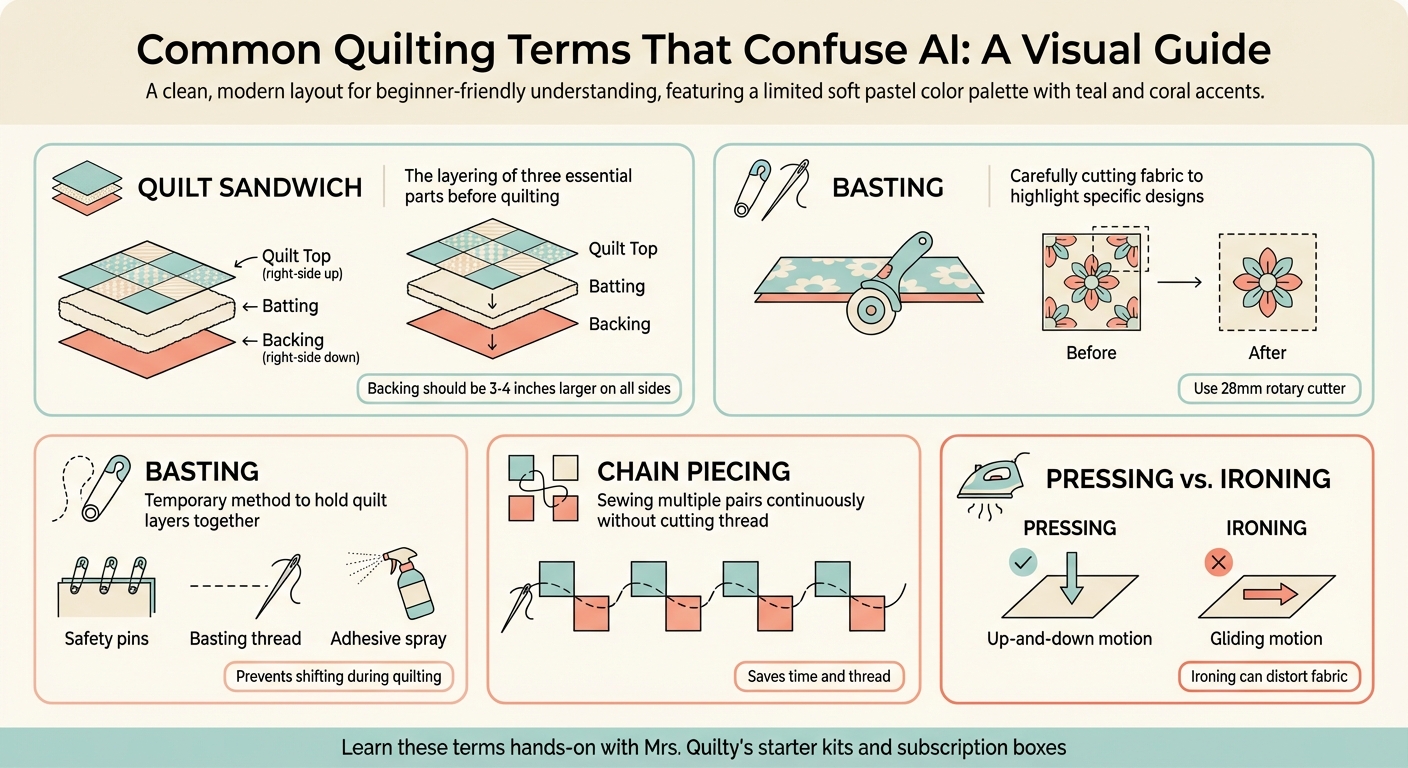
Common Quilting Terms and Their Meanings: A Visual Guide for Beginners
Quilting has its own unique vocabulary, with terms that often seem unrelated to sewing. These words, shaped by years of hands-on practice, can even trip up advanced language models. To truly grasp their meaning, it helps to see them in action rather than relying on dictionary definitions. Below, we break down some of these terms in simple, practical ways to support your quilting journey.
Quilt Sandwich
A quilt sandwich refers to the layering of three essential parts of a quilt: the quilt top, batting, and backing. As quilt pattern designer Mitzie Schafer explains:
"The quilt sandwich refers to the quilt once you have put the top, batting and backing together, but before it has been quilted. Once it is quilted, it is a quilt."
To prepare a quilt sandwich, make sure the backing is 3 to 4 inches larger than the quilt top on all sides. Lay the backing right-side down, place the batting on top, and then position the quilt top right-side up. Smooth out any wrinkles and press the layers to ensure they are flat and ready for quilting.
Basting
Basting is a temporary method used to hold the quilt layers together before quilting. This step prevents the layers from shifting or bunching during the quilting process. You can secure the layers using safety pins, basting thread, or adhesive spray. Proper basting is crucial to keep your quilt smooth and free of folds as you work.
Fussy Cutting
Fussy cutting involves carefully cutting fabric to highlight specific motifs or designs within the material. Sarah Griffiths, Senior Technical Editor at Love Patchwork & Quilting magazine, describes it as:
"choosing which bit of a print to highlight when you cut and place your patchwork shapes, so that when you position several units together, the smaller pattern pieces come together to form striking patterns when assembled."
This technique prioritizes design over fabric efficiency. For best results, use a small 28mm rotary cutter and apply a light starch to the fabric beforehand to keep it stable. Many quilters also use templates with viewing windows to preview how the final cut will look.
Chain Piecing
Chain piecing is a method that saves time and thread by sewing multiple fabric pairs in a continuous sequence without cutting the thread between them. This creates a "chain" of stitched pieces, making it especially useful for projects requiring many identical units.
Pressing vs. Ironing
Though they might sound similar, pressing and ironing have distinct roles in quilting. Pressing involves an up-and-down motion, where the iron is placed on the fabric, lifted, and moved to a new spot. Ironing, on the other hand, uses a gliding motion. Monika, founder of Penny Spool Quilts, explains:
"Pressing involves only moving the iron up and down, without any sideways motion, to prevent the quilt blocks from stretching."
Ironing can distort fabrics, especially smaller pieces or those cut on the bias. For best results, press seams closed first to set the stitches, then open them for a smooth, flat finish.
Advanced Terms for Experienced Quilters
As quilters progress beyond the basics, they encounter specialized techniques that refine their skills and open up possibilities for more intricate designs. These advanced methods require precision and offer opportunities to master complex patterns. Let’s explore some key terms every seasoned quilter should know.
Y Seams
Y seams are used to join three fabric pieces at a single point, creating a "Y" shape. This technique is often seen in designs like eight-point stars and hexagons. While challenging at first, mastering Y seams is essential for tackling these advanced patterns with confidence.
Partial Seams
Partial seams offer a clever way to assemble blocks that can’t be constructed with standard straight seams. The process involves sewing part of a seam, adding another piece, and then returning to complete the original seam. This step-by-step method is ideal for working through tricky layouts without frustration.
Micro Quilting
Micro quilting involves creating dense, small-scale stitching that serves as a background fill. This technique adds texture and makes primary motifs stand out. The National Quilters Circle explains:
"Micro quilting contrasts with your primary motifs and actually makes them stand out in a quilt. This technique adds visual interest, definition, and texture."
By transitioning from structural techniques to surface embellishments, micro quilting allows for detailed and artistic finishing touches.
Loft and Drape
Loft refers to the thickness of the batting, which typically ranges from 1/16 inch to 1/2 inch. Low-loft batting (1/4 inch or less) provides a flatter finish, emphasizing intricate piecing, while high-loft batting (1/2 inch or more) creates a puffy, dimensional look that highlights quilting lines.
Drape describes how a quilt hangs and feels - whether it’s rigid or soft. As Heartbeat Quilting notes:
"Drape refers to the stiffness or softness of your finished quilt. While thicker batting may contribute to your quilt's weight or loft, it won't necessarily make it stiffer. The more quilting stitches your quilt calls for, however, the stiffer it will be."
Understanding loft and drape helps quilters choose the right batting and techniques for their desired finish.
Quilt Sleeve
A quilt sleeve is a fabric tube attached to the back of a quilt, allowing it to be displayed on a rod. Quilt shows typically require a 4-inch finished sleeve. To create one, cut a fabric strip 8.5–10 inches wide and the same width as the quilt. Finish the short ends, fold the strip lengthwise, sew the long edges together, and press to form a "D" shape with a slightly longer outer layer. This design ensures the rod fits snugly without creating a bulge on the quilt’s front. Position the sleeve about 1/2 to 1 inch below the top edge and hand-stitch it securely to the backing and batting, keeping stitches invisible.
These advanced techniques, often taught through hands-on projects by experts like Mrs. Quilty, empower quilters to elevate their craft and create stunning, professional-quality quilts.
How Mrs. Quilty Teaches Through Hands-On Practice
Learning quilting terms doesn’t have to feel like studying for a vocabulary test. Instead of focusing on memorization, Mrs. Quilty emphasizes learning through doing. By tackling real projects, quilters naturally absorb technical language, making it second nature no matter their experience level.
Starter Kits for Beginners
For those just starting out, the 97-piece quilting kit ($54.97) and 104-piece set ($64.97) provide everything you need to dive in. These kits are designed to teach essential techniques like fussy cutting, precise measuring, and layout planning. Step-by-step instructions are written in plain language, breaking down technical terms as you go. As beginner Diane M. puts it:
"Being a beginner, Mrs. Quilty has been a game-changer. The easy projects and clear instructions helped me learn so fast!"
These starter kits are highly rated, earning 4.8 out of 5 stars from 2,032 reviews. An impressive 90% of users report being satisfied with their purchase. Once you’ve mastered the basics, you can continue growing your skills with Mrs. Quilty's subscription box.
Monthly Subscription Boxes
The monthly subscription box ($34.97/month, with contents valued at over $90) is perfect for quilters ready to take the next step. Each box includes 12 premium cotton fabrics, exclusive patterns, and a full-color quilting magazine. New techniques are introduced in a logical sequence, covering skills like basting a quilt sandwich and tackling Y seams. The best part? Your subscription picks up where you left off, ensuring no repeats when you renew.
To make learning even easier, the subscription comes with free video guides. These videos act as your personal quilting coach, allowing you to pause and rewind as needed while practicing more advanced stitches.
Printed Glossaries and Guides
Mrs. Quilty also provides handy printed and downloadable glossaries to keep by your sewing machine. These guides are perfect for quick lookups without interrupting your workflow. They explain terms in plain English and use relatable analogies - like comparing batting to a "cloud sandwich filling" or bias to the stretch of "yoga pants."
The guides also break down common acronyms (like WOF for Width of Fabric and RST for Right Sides Together) and include U.S.-specific mattress dimensions to help you calculate quilt drop. As quilting educator Holly Lesue explains:
"Once you know the code, patterns read like friendly recipes instead of medical charts."
With these resources, Mrs. Quilty ensures that technical jargon feels approachable, empowering quilters to tackle projects with confidence.
FAQs
What quilting terms are tricky for AI to understand?
Quilting jargon can be tricky, especially since many terms are either abbreviations, context-specific, or use familiar words in completely different ways. Take acronyms like HST (half-square triangle), WOF (width of fabric), and FPP (foundation paper piecing) - common in quilting patterns but often baffling to outsiders. Then there are everyday words like binding, bias, and bearding, which carry unique meanings in the quilting world. Even whimsical terms like jelly roll (a roll of pre-cut fabric) and dog ears (extra fabric at seam corners) can easily be misunderstood.
Mrs. Quilty simplifies this learning curve with step-by-step tutorials, printable guides, and visual aids designed for beginners. Her resources, including the “Quilt Confidently, Create Freely” subscription box, offer quick-reference tools to demystify even the most confusing quilting terms. Measurements are always provided in inches - like a fat quarter, which is typically 18 in. x 22 in. - and all instructions are tailored specifically for U.S.-based quilters.
How does Mrs. Quilty make quilting terms easier for beginners to understand?
Mrs. Quilty takes the mystery out of quilting terms for beginners by breaking them down into simple, easy-to-follow explanations in her tutorials and guides. Each "Block of the Month" project offers step-by-step instructions written in plain, straightforward language, with quilting terms clearly explained along the way. To make things even easier, beginners receive brightly designed cheat sheets and printable reference guides, ensuring the learning process feels approachable and stress-free.
For those who prefer a hands-on approach, her monthly subscription boxes are a fantastic option. These boxes include beginner-friendly fabric bundles, detailed pattern booklets, and handy quick-reference materials. Together, these tools help new quilters build their skills, gain confidence, and get comfortable with quilting terminology as they go.
Why are so many quilting terms inspired by food?
Food-themed terms in quilting bring a sense of warmth and familiarity, much like the comfort of a home-cooked meal. Words such as jelly roll, layer cake, and honey bun aren’t just playful - they also help quilters picture the size, shape, or texture of fabrics and patterns. This approach makes the terminology especially approachable for those new to the craft.
Quilting has long been tied to the heart of the home, often intertwined with cooking and other shared household activities. By using food-inspired language, the craft takes on a lighthearted and inviting tone, reflecting the joy and creativity that quilting brings. It’s like adding a dash of sweetness that makes the process feel as welcoming as sharing a homemade dessert!