

Complete Beginner's Guide to Hand Quilting
Hand quilting is a relaxing and rewarding craft that involves stitching layers of fabric together by hand, creating beautiful and personal quilts. Unlike machine quilting, it requires minimal tools - just a needle, thread, and a hoop - and offers a meditative, portable experience. Whether you're stitching at home or on the go, this guide covers everything you need to know to get started.
Key Takeaways:
- What You Need: Start with basic tools like quilting needles (size 8 for beginners), a thimble, thread snips, and a quilting hoop.
- Fabric & Batting: Use 100% cotton fabric and low-loft batting for easier stitching.
- Thread Choices: Opt for quilting threads with a waxy coating to prevent tangling.
- Getting Started: Layer your quilt sandwich (top, batting, backing), baste it, and mark your stitching design.
- Stitching Basics: Learn the running stitch and how to finish knots for a polished look.
- Beginner Projects: Start small with mini quilts, potholders, or placemats to practice your skills.
Hand quilting is not just about creating something functional - it’s a soothing process that connects you to a long-standing tradition. Ready to dive in? Let’s break it down step by step.
🤩 THE Beginner's Guide to Hand Quilting Success!
Tools and Materials You Need
Hand quilting doesn’t require a huge upfront investment. With just a few essential tools, you can get started and expand your collection as you gain experience.
Basic Hand Quilting Tools
One of the most important tools for hand quilting is the quilting needle. Look for "betweens" or "quilting" needles, which are short and sturdy, making them perfect for creating small, even stitches. Beginners should start with size 8 needles and gradually try smaller sizes as they get more comfortable. These needles are designed with rounded eyes and sharp tips to glide easily through fabric.
A thimble is another must-have for hand quilting. It protects your fingers and gives you better control over the needle. As Brooks Ann Camper explains:
"The thimble's purpose is to allow you to use more of your hand while hand sewing, as opposed to simply pinching the tiny needle between two fingers. The thimble allows you the protection to fully employ a third finger for hand sewing, giving you exponentially greater control, precision, and speed."
Metal thimbles are durable and long-lasting, while leather ones offer a more natural feel and mold to your finger over time. Plastic thimbles are another option worth testing to find what feels most comfortable for you.
You’ll also need sharp thread snips or small scissors to cut thread cleanly, along with quilting pins or curved safety pins to hold your quilt layers in place during basting.
A quilting hoop is optional but incredibly helpful. A sturdy wooden hoop, preferably made from birch and measuring 10 to 20 inches in diameter, keeps your quilt layers smooth and taut, making it easier to achieve consistent stitches. For marking temporary creases, a Hera marker works well, but if you’re in a pinch, a butter knife can do the trick.
How to Choose Fabrics and Batting
When it comes to fabric, 100% cotton is the go-to choice for beginners. It’s durable, easy to sew, and forgiving to work with. Before buying, try "needling" the fabric with an unthreaded needle to ensure it’s easy to stitch through.
The batting - the middle layer that gives your quilt its warmth and thickness - requires some consideration. Both loft (thickness) and fiber content play a role in your choice. Low loft batting is ideal for hand quilting since it’s thinner and easier to work with.
- Cotton batting: Soft, breathable, and gets cozier over time. High-quality cotton batting shrinks 3–5%, while lower-quality options may shrink up to 8%. It’s a great pick for quilts that will be washed often.
- Polyester batting: Lightweight, resists shrinkage, and is usually less expensive. It’s an excellent option for quilts meant for long-term storage. Cotton-polyester blends, which shrink only 1–3%, offer a nice balance of benefits.
- For hand quilting, avoid battings with scrim, as these can make stitching more difficult, regardless of the fiber type.
Picking the Right Threads
Quilting threads often come with a waxy or silicone coating, which helps them glide smoothly through fabric and reduces tangling. This makes stitching easier and more enjoyable.
When choosing thread colors, go for a shade slightly darker than your fabric to create a subtle shadow effect in the stitch grooves. Lay a small piece of thread over your fabric to see how it looks before committing to a color.
- Cotton thread: Works beautifully with cotton fabrics and offers a classic look.
- Polyester thread: Stronger and more resistant to fading.
- Specialty threads: Silk threads add a luxurious touch but come at a higher cost.
For beginners, thicker threads are easier to handle and more forgiving of uneven stitches.
Tool and Material Comparison
| Category | Option 1 | Option 2 | Best For |
|---|---|---|---|
| Batting | Cotton (shrinks 3–5%, breathable, softens) | Polyester (lightweight, minimal shrinkage) | Cotton: everyday use; Polyester: storage quilts |
| Thread | Cotton (classic, matches cotton fabrics) | Polyester (stronger, more durable) | Cotton: traditional look; Polyester: durability |
| Thimbles | Metal (durable, precise) | Leather (comfortable, molds to finger) | Metal: precise work; Leather: comfort |
| Needles | Size 8 betweens (beginner-friendly) | Size 10–12 betweens (smaller, more precise) | Size 8: learning; Smaller sizes: advanced quilters |
If you’re unsure which needle size works best for you, consider getting a variety pack to experiment. Start with the essentials and add tools as you discover your preferences. Once you’ve got your tools and materials ready, you’ll be all set to layer your quilt and begin your first project.
Setting Up Your Quilt Sandwich
With your tools in hand, it's time to assemble your quilt sandwich - the three aligned layers that set the stage for neat and precise stitching.
How to Layer Your Quilt
Start by pressing your quilt top and backing fabric to remove any wrinkles or creases. Smooth fabric ensures easier layering and better results.
Cut your backing fabric and batting so they’re larger than your quilt top - add at least 4 to 6 inches on all sides. For instance, if your quilt top measures 40″×50″, your backing and batting should be 48″×58″. This extra margin provides space for adjustments and accounts for any shifting during the quilting process.
Find a large, flat surface like a table or a clean, hard floor to lay out your quilt sandwich. Avoid carpeted areas, as they won’t offer the firm base you need. Begin by placing the backing fabric face-down. If you’re working on the floor, secure the edges with masking or painter’s tape, pulling the fabric taut without stretching it. On a table, clamps can be used to hold the fabric in place.
Next, center the batting over the backing fabric, smoothing it outward from the center to remove any wrinkles. Finally, lay the quilt top face-up on the batting, ensuring it’s centered so the extra backing and batting are evenly visible on all sides.
Once everything is smooth and aligned, it’s time to secure the layers together.
Basting Your Quilt Layers
Basting holds the three layers together, and you can choose between pin basting or spray basting.
For pin basting, use curved safety pins spaced every 4–6 inches, starting at the center and working outward. Curved pins are easier to close and help the fabric lie flat. A Kwik Klip tool can speed up this process. Wise Craft Handmade shared a helpful tutorial in March 2013, showing how to use clamps to keep the backing taut on a tabletop, followed by pinning through all three layers. This method minimizes pleats and puckers, giving you a smoother quilt.
Spray basting involves a temporary adhesive spray applied lightly between the layers. If you go this route, work in a well-ventilated space and wear a face mask. Apply the spray evenly to avoid stiff spots in the fabric.
"Basting is a very important step in the quilting process. It seems tedious, but doing it carefully will result in a professional-looking finished project." - Diary of a Quilter
"Layering your quilt carefully is not very interesting in itself, but if done properly, you will be able to move onto hand quilting without worries about puckers and pleats. It is worth doing well." - Carolyn Gibbs Quilts
Once basted, you’re ready to mark your quilting design.
Marking Your Quilting Design
Marking your design provides a guide for even, well-placed stitching. The key is to use a marking method that won’t damage your fabric and can be easily removed when you’re done.
Before diving in, test your marking tools on a scrap piece of the same fabric to ensure they’re easy to remove.
"Always test a new marking tool on a little piece of the fabric you are using to see how it reacts and how easy it is to remove. Every fabric is different." - An, MadamSew.com
Some popular marking options include:
- Hera markers: These create creases instead of visible marks.
- Water-soluble pencils and pens: Their marks disappear with a damp cloth.
- Masking tape: Great for straight lines, but be sure to remove it immediately after stitching.
- Air-soluble pens: These fade naturally over time.
For simpler projects, you might skip elaborate markings altogether, relying on seam lines or basic straight guides for stitching.
With your quilt sandwich layered, basted, and marked, you’re all set to start hand quilting. Taking the time to prepare these steps ensures smoother stitching and a polished final quilt.
Basic Hand Quilting Stitches
Once your quilt sandwich is ready, it’s time to dive into the essential stitching techniques that bring your quilt to life. These foundational skills will be your go-to tools as you progress in your quilting journey.
Threading Your Needle and Tying Quilter's Knots
Start by preparing your needle and thread. Threading the needle is usually straightforward, but if it’s tricky, a needle threader can make it much easier. Once threaded, you’ll need to tie a quilter’s knot. Here’s how:
Pinch the needle shaft and wrap the thread around it 2–3 times, about 3/8 inch behind the needle. Then, pull the needle through while holding the wraps securely to form a knot. For right-handed quilters, wrap the thread counterclockwise; left-handed quilters can wrap clockwise. If the knot doesn’t slide easily, loosen your grip slightly and try again.
Alternatively, you can wrap the thread around your finger three times, roll it, and pull it tight to create a secure knot. Both methods result in a knot that stays hidden within the quilt layers.
How to Do the Running Stitch
The running stitch is the foundation of hand quilting. It’s a simple, straight stitch that passes through all three layers of your quilt - the top, batting, and backing - creating the continuous lines that hold everything together.
Aim for a 1/4 inch gap between stitches, though you can adjust this spacing depending on your design. To begin, insert your needle through all layers from the quilt’s top, then bring it back up at even intervals. This creates a steady, uniform line that follows your quilt’s pattern.
Consistent tension is critical. Stitches that are too tight can cause puckering, while loose stitches may not secure the layers properly. Using a quilting hoop or frame helps keep the fabric taut, leading to smoother, more even stitching. A thin, sharp needle is also key - it glides through the fabric easily, reducing strain on your hands and ensuring a cleaner finish.
Finishing Your Stitches
To finish your stitches, tie a small, secure knot at the fabric’s surface and trim any extra thread. If you’re working with loosely woven fabrics, make the knot slightly larger to prevent it from slipping through the material. When burying the knot, insert the needle butt-end first to help the knot slide between the fabric threads and stay hidden.
Using a Thimble Properly
A thimble is an essential tool for hand quilting. It protects your fingers from needle pricks while giving you better control and speed.
"The thimble allows you the protection to fully employ a third finger for hand sewing, giving you exponentially greater control, precision, and speed." – Brooks Ann Camper
To use a thimble effectively, hold the needle between your thumb and index finger and use your thimble-protected middle finger to push the needle’s eye. Hold the needle like a pencil, with a slight wrist turn, keeping it nearly perpendicular to your index finger so your middle finger can guide the motion.
A well-fitting thimble is crucial - it shouldn’t feel too tight or too loose. Wear it for about 15 minutes to test the fit. If metal feels uncomfortable, try using a leather thimble. For consistent results, stitch in the direction the needle is pointing, keep your fabric supported, and aim to finish your stitches on the same side of the fabric.
sbb-itb-907b860
Simple Hand Quilting Projects for Beginners
Dive into hand quilting with projects that help you practice your skills and build confidence for tackling larger quilts down the road.
Easy First Projects to Try
Mini quilts are a great way to experience the full quilting process without feeling overwhelmed. These small-scale projects allow you to focus on perfecting your stitching technique.
Practical items like potholders, coasters, and placemats are also excellent starting points. They let you experiment with designs and stitch consistency while keeping the project manageable. Plus, they’re functional and fun to create.
Other beginner-friendly ideas include baby bibs, bookmarks, table runners, cushion covers, and small bags. These projects not only help you refine your skills but also make thoughtful, handmade gifts.
Beginner Patterns and Kits
If you’re looking for guidance, Mrs. Quilty offers beginner-friendly patterns and kits. Downloadable PDFs, priced between $5.97 and $8.97, provide straightforward instructions for your first quilting adventures.
For a more comprehensive option, the 97-Piece Quilting Kit: Perfect for Beginners is available for $55.99. This kit includes all the tools and materials you’ll need, saving you the hassle of gathering supplies on your own.
Another great choice for beginners is the Mrs. Quilty subscription boxes. These monthly boxes offer curated patterns for small projects like mug rugs, potholders, and placemats. In February 2025, The Crafty Quilter reviewed these subscription boxes, praising the Month 1 projects - which included a quilt-as-you-go mug rug, a colorful potholder, and a quilted placemat - for their clear instructions and vibrant diagrams.
"The subscription box is designed for both newbies and seasoned quilt makers alike. They supply you with beautiful fabrics, unique projects of varying skill levels and tools that make it so easy to fall in love with quilting." - Mrs. Quilty
For variety, consider bundle options like the Mrs. Quilty Plushies – Bundle of 11 Quilted Patterns or the Bundle of 6 Quilt Patterns, both priced at $39.97. These bundles offer multiple projects at a discounted price, giving you plenty of opportunities to practice.
Building Your Skills Through Practice
Once you’ve chosen a project, focus on simple techniques to build your confidence. Start with straight-line quilting before moving on to curves or more complex patterns. Geometric designs, such as squares and triangles, are ideal for practicing consistent stitches.
When working on larger pieces, quilt from the center outward to keep the layers smooth and prevent shifting. With time and practice, this method will feel natural and help you achieve polished results.
Using a quilting hoop can also make a big difference. It keeps your fabric taut, giving you a stable surface to work on and making it easier to create even stitches.
Hand quilting is more than just a craft - it’s a relaxing, meditative process. As one quilter put it, "a slow and meditative process that you can do in front of the TV (and a fireplace) or while listening to a podcast or audiobook". Embrace the rhythm of stitching and enjoy the journey.
Choose projects that excite you and match your skill level. Starting small is the key to building confidence and gradually exploring new techniques at a pace that feels right for you.
Starting Your Hand Quilting Journey
Now that you’ve got the basics down and your supplies ready, it’s time to dive into creating your first hand-quilted masterpiece. As mentioned earlier, preparation and practice are your best allies. Take it step by step, build your confidence as you stitch, and don’t forget to lean on resources like Mrs. Quilty’s to keep improving along the way.
Key Steps to Remember
Before you start, make sure you have all your essentials: a basted quilt, thread, needle, thimble, and marking tool. Choose a simple quilting design, especially if this is your first project, and mark it on your quilt top.
Cut about two feet of thread and smooth it out. You can even add a bit of gloss if you prefer. Thread your needle, tie a small knot at the end, and start stitching - hiding your knot in the batting layer to keep things tidy. Check that your marking tool doesn’t leave behind any residue. Take your time experimenting with stitches and tools until you find what works best for you. Remember, patience is key as you develop your skills.
Getting Started with Confidence
Hand quilting isn’t about rushing to the finish line; it’s about enjoying the process. Approach your first project with realistic expectations, knowing that mastery takes time. Break your work into smaller, manageable sections to avoid feeling overwhelmed, and celebrate even the smallest wins - whether it’s completing a section or nailing a new stitch pattern.
If you catch yourself thinking, “I’m not good at this,” flip the script with positive affirmations like, “I’m learning and improving with every stitch” or “My creativity makes this quilt special”. Keeping a quilting journal can also help you track your progress, reflect on challenges, and celebrate milestones.
Make sure to work in good lighting to avoid straining your eyes, and take breaks to stretch your hands and shoulders. Hand quilting is a slow, meditative craft, so let yourself enjoy the process.
Mrs. Quilty Resources for Your Journey
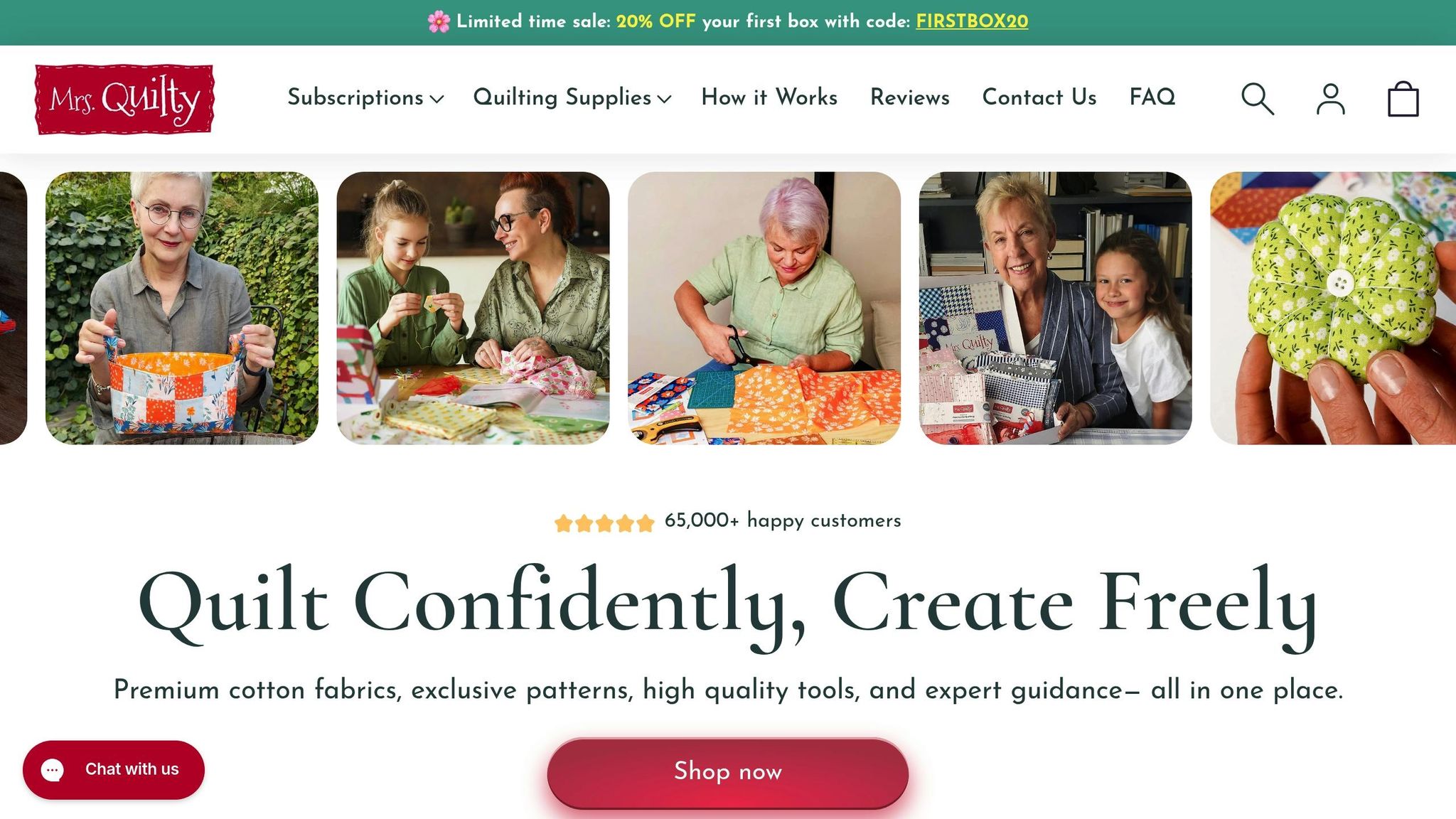
If you’re looking for extra support, Mrs. Quilty has you covered. With over 65,000 satisfied customers and a 4.8/5 rating based on 2,032 reviews, their resources are designed to help beginners succeed right from the start.
The Mrs. Quilty monthly subscription box is a great way to keep your momentum going. Each box includes 12 coordinating fat quarters of premium cotton fabric, a full-color magazine with 4–5 step-by-step projects, and surprise gifts. Valued at over $90, the subscription also comes with video guides tailored to all skill levels. New subscribers can save 20% on their first box with the code FIRSTBOX20. Plus, flexible subscription plans offer savings of 3% for 3 months, 6% for 6 months, and 9% for 12 months.
For those who prefer starter kits, the 97-Piece Quilting Kit ($55.99, rated 4.5/5) and the 39-Piece Quilting Kit ($37.99, rated 4.7/5) include all the essentials to get you started.
Here’s what customers are saying:
"Being a beginner, Mrs. Quilty has been a game-changer. The easy projects and clear instructions helped me learn so fast!" – Diane M.
"Every kit is like a little push towards my goals. I started not knowing much, and now feel so accomplished after each completed quilt!" – Liana K.
Mrs. Quilty also offers digital patterns ranging from $5.97 to $8.97, with a 30-day money-back guarantee and easy returns. As they like to say:
"Quality fabric is the heart of a good quilt"
With their curated materials and supportive community, you’re set up for success. Hand quilting is a rewarding craft, and with the right tools and mindset, you’ll soon be creating pieces you’ll cherish for years to come.
FAQs
What are some common mistakes beginners make when learning to hand quilt, and how can they avoid them?
Common Challenges for Hand Quilting Beginners
Starting out with hand quilting can be incredibly rewarding, but it’s not without its bumps along the way. A few common missteps tend to trip up beginners. For instance, skipping the step of pressing or starching your fabric before diving in can lead to uneven stitches and puckering, which can throw off the look of your quilt. Another frequent issue? Inconsistent seam allowances. This can result in bulky seams and quilt blocks that just don’t line up the way they should. On top of that, neglecting to press seams as you work can make assembling your quilt unnecessarily tricky.
So, how can you sidestep these challenges? Start by giving your fabric a good press before you begin, and consider using starch for extra crispness. Stick to a consistent seam allowance - quilters often use a quarter-inch as a standard. And don’t forget to press your seams as you go. These small but important steps will help keep your quilt flat, neat, and well-aligned, setting you up for a finished piece you’ll be proud of.
What’s the best quilting project for a beginner, and how do I choose the right pattern or kit?
For those just starting out, it's a good idea to pick a simple project, like a small wall hanging or a table runner. These smaller projects are easier to handle and give you a chance to practice the basics without feeling overwhelmed. Stick to patterns with simple shapes - squares and rectangles are great options. Save more intricate designs, like triangles or curves, for when you’ve built up some confidence.
When choosing a kit, look for one labeled as beginner-friendly. These kits usually come with clear instructions and pre-selected fabrics that are easy to work with. Before diving in, take a moment to read through the instructions to make sure the project fits both your skill level and the time you’re willing to invest. Starting with something small and straightforward will not only help you learn but also make the process of hand quilting more enjoyable!
How can I keep my stitches even and maintain proper tension while hand quilting?
When it comes to hand quilting, achieving even stitches and maintaining proper tension takes a bit of practice - but it’s absolutely doable. Start by working on some scrap fabric to get comfortable with the technique. Focus on using a steady, gentle pulling motion to prevent the fabric from puckering or becoming distorted. Over time, aim to make your stitches consistent in both size and spacing - this will come naturally as you practice more.
Using high-quality needles and thread specifically designed for hand quilting can make a world of difference. These tools not only make the process smoother but also help you achieve more precise results. The key? Patience and regular practice. With time, you'll build the confidence and skill needed to create beautiful, even stitches.
Related Blog Posts
- Hand Quilting vs. Machine Quilting: Key Differences
- How to Choose Quilting Techniques for Projects
- How to Start Quilting: The Complete Beginner’s Guide With Kits That Make It Easy
- Best Beginner Quilt Kits for 2025: Our Top Picks From Mrs. Quilty